1

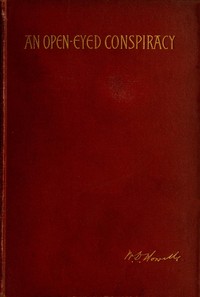
An Open-Eyed Conspiracy; An Idyl of Saratoga — Inside the Classic
(0 User reviews)
408
Project Gutenberg
2002
Not confirmed
New York (State) -- Fiction; Saratoga Springs (N.Y.) -- Fiction; Saratoga (N.Y.) -- Fiction
Readers of public-domain and historical texts
Project Gutenberg digital edition
en
Edition facts
Words
42,853
Reading time
187 min
Text sections
19
An Open-Eyed Conspiracy; An Idyl of Saratoga — Inside the Classic can be approached with a clearer sense of reading commitment from its source measurements: 42,853 words, 3 hr 7 min estimated reading time, and 19 detected text sections.
The text analysis averages about 19.2 words per sentence, while the detected sections provide another way to judge how the source is divided.
Project Gutenberg metadata also associates the work with “New York (State) -- Fiction,” connecting these edition facts with the source record’s subject description.
Source:
Project Gutenberg record #3051
Howells uses a first-person narrator, Basil March, whose self-deprecating observations and ironic asides shape the story. The excerpts show a voice that shifts between leisurely description and sharp social commentary, with a pace that mirrors the languid summer setting of Saratoga Springs.
Editorial Edition Score
4.8/5
★★★★★
★★★★★
Calculated from edition completeness, EPUB availability, text structure and catalogue metadata. Not a user rating.
How this score is calculated
- Description quality20 pts
- Title & short description10 pts
- Source metadata20 pts
- Text length15 pts
- Chapters / structure15 pts
- EPUB file integrity20 pts
Total of 100 points, scaled to a 2.5-5.0 range. Editions with an empty description or a missing EPUB file are not scored.
Edition quality
Public-domain source text
Read the source text
The source text is kept in the dedicated reader, separate from this catalogue record and its commentary.
The narrative voice in An Open-Eyed Conspiracy is immediately distinctive: Basil March, the first-person narrator, speaks in a tone of wry self-awareness and gentle irony. He describes Saratoga's stifling heat with a mixture of complaint and amusement, noting how the trees 'embower and stifle' the town. His observations are precise—he notes the 'arabesque pavilion' and debates whether it is Swiss or Turkish, settling on 'Grecian kiosk' as a compromise. This playful attention to detail sets the pace for a story that moves slowly, like a summer afternoon, but is punctuated by moments of sharp social insight.
A Voice of Ironic Observation
March's narration is full of self-deprecating humor and a tendency to undercut his own seriousness. He admits to 'studying to deceive myself' about the coolness of the spring, and later confesses a 'foible' for checking news-stands for his own periodical. This voice creates a sense of intimacy with the reader, as if March is confiding his petty vanities. The irony extends to his observations of others: he watches a French-Canadian mother scold her child, then notes that she is 'not so very much cleaner herself.' Such details reveal a narrator who is both compassionate and critical, never fully trusting his own judgments.
Pace and the Rhythm of Saratoga
The pacing of the excerpts mirrors the languid atmosphere of Saratoga. Sentences are often long and meandering, filled with parenthetical asides and qualifying clauses. For example, March describes the park's pavilion in a series of hesitant revisions: 'I call it arabesque in despair; it might very well be Swiss; it is charming, at all events.' This rhythm slows the reader down, evoking the heat and idleness of the setting. Yet the pace quickens when dialogue or action occurs, such as the exchange about Every Other Week or the negotiation over paying for carriage rides. These shifts in tempo reflect March's own mental movements between reverie and engagement.
Social Dynamics Through Dialogue
Dialogue in the excerpts reveals character and social hierarchy with economy. When March suggests that women read with an 'utterly unliterary sense,' Kendricks evades the comment, showing his delicacy. Later, Miss Gage's request to pay her share—'with many blushes'—exposes her discomfort and pride. March's wife mocks him gently, saying 'Mr. March wants to see if they have the last number of Every Other Week,' a line that encapsulates their marital dynamic. These exchanges are brief but layered, advancing the plot while deepening our sense of the characters' relationships and the social codes of Saratoga.
Readers should attend to the way Howells uses March's voice to filter every scene. The narrator's unreliability—his self-mockery and selective attention—means that events are never presented straight. The pace, too, is a deliberate choice: slow passages invite reflection, while quicker exchanges advance the social comedy. Pay attention to how March's observations of others often reveal more about himself than about them.
I remembered sitting on a splintered porch, reading Howell’s narrator fussing over Saratoga’s rituals, and how his quiet irony felt like a hand on my shoulder. That same gentle distance returned in Stories By English Authors: France (Selected by Scribners) — Background and Themes, where foreign observances became mirrors, not judgments. Both felt less like stories, more like someone breathing near me in a hot room.
There are no reviews for this eBook.
There are no comments for this eBook.
Reader reflection
How will you remember this book?
Save your reaction, strongest insight, and memorable passage.
Your progress
0
/
10
2
Did this book hold your interest?
3
Would you pass this book on to a friend?
4
How much effort did this book require?
5
Would this book work well in a reading group?
6
Which part made the strongest impression?
7
Could you see yourself revisiting this book?
8
Was the book moving at the right speed?
9
In one sentence, what did you learn?
10