
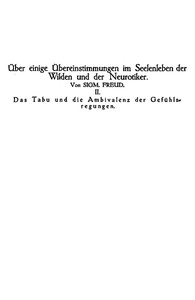
Das Tabu und die Ambivalenz der Gefühlsregungen by Sigmund Freud
Don't go into this expecting a novel with a plot. This is Freud in full essay mode, piecing together a theory about human nature from anthropology, his clinical work, and sharp observation. The 'story' is the argument he builds.
The Story
Freud starts by looking at ancient taboos, like the rules surrounding kings, the dead, or enemies. He notices these taboos aren't just laws; they're charged with a powerful emotional dread. Why? He proposes that a taboo points directly to a hidden, unconscious desire. We forbid something so strongly because, on some level, we desperately want it. This creates 'ambivalence'—simultaneous attraction and repulsion. The book walks us through how this ambivalence shapes everything from our relationships with parents (the famous Oedipus complex gets a mention) to our feelings about death and those in power. The narrative is the logic of his case, showing how inner conflict becomes the engine for outer rules.
Why You Should Read It
Reading this feels like getting a backstage pass to the human mind. Even if you don't buy all of Freud's conclusions, his core idea—that we are often at war with ourselves—is incredibly powerful. It gives you a framework to understand why you might snap at someone you love, or feel guilty about a thought you didn't choose to have. It takes judgment out of the equation and replaces it with curiosity. For me, the most striking part was how he links personal psychology to the structure of society. It makes you wonder: how many of our current social 'taboos' are operating on the same ancient, conflicted fuel?
Final Verdict
This is for the curious reader who likes to dig into big ideas about why people act the way they do. It's perfect for anyone interested in psychology, philosophy, or cultural studies, but you don't need a degree to get something out of it. Be prepared for dense, sometimes repetitive, early-20th-century academic prose—it's a workout. But if you stick with it, you'll find insights that feel startlingly relevant to understanding modern life, from political polarization to internet outrage. Just don't expect easy answers; Freud is all about exploring the uncomfortable, complicated questions.
Michael Anderson
1 year agoIf you enjoy this genre, the plot twists are genuinely surprising. This story will stay with me.
Anthony Hill
6 months agoI stumbled upon this title and it provides a comprehensive overview perfect for everyone. This story will stay with me.
Michael Lewis
4 months agoGreat reference material for my coursework.
Ava Allen
3 weeks agoA bit long but worth it.





Thomas Perez
5 months agoI have to admit, the arguments are well-supported by credible references. Exceeded all my expectations.