1

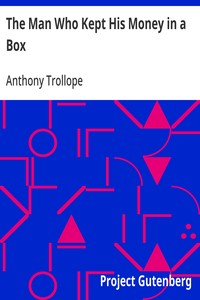
The Man Who Kept His Money in a Box — Reading Notes
(0 User reviews)
1418
Project Gutenberg
2003
Not confirmed
Short stories; Travelers -- Fiction; British -- Europe -- Fiction
Readers of public-domain and historical texts
Project Gutenberg digital edition
en
Edition facts
Words
15,112
Reading time
66 min
Text sections
2
The Man Who Kept His Money in a Box — Reading Notes can be approached with a clearer sense of reading commitment from its source measurements: 15,112 words, 1 hr 6 min estimated reading time, and 2 detected text sections.
The text analysis averages about 18.4 words per sentence, while the detected sections provide another way to judge how the source is divided.
Project Gutenberg metadata also associates the work with “Short stories,” connecting these edition facts with the source record’s subject description.
Source:
Project Gutenberg record #3767
Trollope's story follows a chance encounter with a secretive English traveler, Mr. Greene, whose habit of hoarding cash in a locked box unravels during a Swiss-Italian journey. The first-person narrator, Robinson, becomes entangled in the Greenes' crisis when the box vanishes, exposing tensions between thrift, trust, and social obligation.
Editorial Edition Score
4.5/5
★★★★★
★★★★★
Calculated from edition completeness, EPUB availability, text structure and catalogue metadata. Not a user rating.
How this score is calculated
- Description quality20 pts
- Title & short description10 pts
- Source metadata20 pts
- Text length15 pts
- Chapters / structure15 pts
- EPUB file integrity20 pts
Total of 100 points, scaled to a 2.5-5.0 range. Editions with an empty description or a missing EPUB file are not scored.
Edition quality
Public-domain source text
Read the source text
The source text is kept in the dedicated reader, separate from this catalogue record and its commentary.
The story opens with the narrator, Robinson, spotting a man's nose pressed against a carriage window in the Via Mala gorge—an image that immediately signals physical discomfort and a reluctance to engage with the landscape. This man, later known as Mr. Greene, is introduced through a series of brief encounters at inns and passes, each adding a layer of suspicion about his character. Trollope builds the narrative around a single, tangible object: a box containing Greene's savings, which becomes the focal point of anxiety and conflict. The first-person voice is wry and self-aware, often commenting on the absurdity of the situation while maintaining a tone of polite exasperation.
A Narrator Caught Between Curiosity and Duty
Robinson’s narration is marked by a tension between his own plans and the obligations thrust upon him. He describes Greene’s nose pressed to the glass, then later mimics the man’s gesture of pointing to his open mouth to explain a fear of sore throat—a detail that reveals Greene’s cautious, almost hypochondriac nature. The narrator’s voice shifts from detached observation to reluctant involvement: “The Greenes were nothing to me,” he insists, yet he agrees to search for the missing box. This internal conflict drives the story’s pace, as Robinson’s irritation grows with each failed lead. His asides—such as noting that his future wife was among the friends he was to meet in Innsbruck—add a layer of personal stakes that complicate his role as a mere helper.
The Box as a Source of Social Friction
The missing box does more than deprive Greene of funds; it exposes the fragility of social bonds among travelers. Mrs. Greene’s dramatic cry, “My jewels!” and her husband’s despairing “What am I to do for my money?” reveal a family dependent on a single, insecure asset. The narrator’s suspicion that the Greenes might be “a family of swindlers” underscores the distrust that arises when money is hidden rather than managed through visible means like banknotes or credit. Trollope uses the box to critique a particular kind of thrift that isolates its owner and creates vulnerability. The daughter, Sophonisba, whispers to Robinson, “They will think we are all sharpers,” showing how the loss threatens their reputation as much as their finances.
Pace and the Accumulation of Detail
Trollope controls the story’s rhythm through a series of small, accumulating frustrations. The narrator’s journey to Como and Milan is recounted in a flat, weary tone: “I went to Como by the afternoon steamer, and spent a long dreary evening down on the steamboat quays searching everywhere, and searching in vain.” The repetition of place names and the lack of scenic description emphasize the tedium of the search. Dialogue becomes clipped and repetitive—Greene’s “What ought I to do?” and the Boots’ “Has Monsieur found the accursed trunk?”—mirroring the circular nature of the investigation. This deliberate pacing contrasts with the initial rapid movement through Alpine passes, creating a sense of entrapment that mirrors Greene’s own predicament.
Readers attentive to narrative voice will notice how Robinson’s self-deprecating humor and occasional sharpness color every scene. The story rewards close attention to small gestures—a pointed finger, a whispered confidence—that reveal character more directly than grand declarations. Trollope’s use of a first-person narrator who is both participant and commentator invites the reader to weigh the reliability of his judgments, particularly as his own interests subtly shape the tale.
That rainy afternoon, I kept returning to Robinson’s unease with Mr. Greene’s locked box—how trust curdles without transparency. The thought lingered, an odd ache, until I reached for The Daughter of an Empress — Context and Discussion almost without deciding. There, secrecy wore a crown instead of a coat, and the same quiet dread felt heavier.
There are no reviews for this eBook.
There are no comments for this eBook.
Reader reflection
How will you remember this book?
Save your reaction, strongest insight, and memorable passage.
Your progress
0
/
10
2
What was your overall reaction to the book?
3
How likely are you to recommend this book?
4
How demanding did the text feel?
5
What did you appreciate most?
6
How understandable was the text?
7
Could you see yourself revisiting this book?
8
Was the book moving at the right speed?
9
In one sentence, what did you learn?
10