1

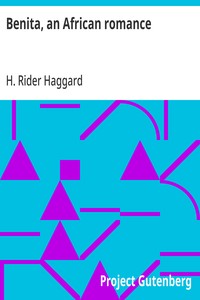
Benita, an African romance — Context and Discussion
(0 User reviews)
109
Project Gutenberg
2006
Not confirmed
Adventure and adventurers -- Fiction; Africa, East -- Fiction
Readers of public-domain and historical texts
Project Gutenberg digital edition
en
Edition facts
Words
81,928
Reading time
357 min
Text sections
26
This digital edition of Benita, an African romance — Context and Discussion is described by source-level measurements including 81,928 words, 5 hr 57 min estimated reading time, and 26 detected text sections.
The text analysis averages about 18.6 words per sentence, while the detected sections provide another way to judge how the source is divided.
Project Gutenberg metadata also associates the work with “Adventure and adventurers -- Fiction,” connecting these edition facts with the source record’s subject description.
Source:
Project Gutenberg record #2761
H. Rider Haggard's 1906 romance follows Benita Clifford in Portuguese East Africa, where a clairvoyant bond with a sinister partner and a legendary Portuguese treasure buried near the Zambesi drive a narrative of psychological tension and colonial adventure.
Editorial Edition Score
4.8/5
★★★★★
★★★★★
Calculated from edition completeness, EPUB availability, text structure and catalogue metadata. Not a user rating.
How this score is calculated
- Description quality20 pts
- Title & short description10 pts
- Source metadata20 pts
- Text length15 pts
- Chapters / structure15 pts
- EPUB file integrity20 pts
Total of 100 points, scaled to a 2.5-5.0 range. Editions with an empty description or a missing EPUB file are not scored.
Edition quality
Public-domain source text
Read the source text
The source text is kept in the dedicated reader, separate from this catalogue record and its commentary.
H. Rider Haggard's Benita, an African Romance opens with a striking image: the black smoke from a mail steamer's funnels lying low over the sea like 'vast, floating ostrich plumes.' This visual precision, typical of Haggard's adventure writing, immediately establishes a world where natural beauty and human tension coexist. The novel's structure alternates between shipboard confidences, overland travel, and the claustrophobic atmosphere of a camp where the heroine, Benita, finds herself mentally linked to the enigmatic Jacob Meyer. Haggard builds suspense not through action alone but through the slow revelation of a psychic intimacy that Benita both fears and cannot escape.
A Psychic Link Forged in Firelight
The most unusual element in this romance is the telepathic connection between Benita and Jacob Meyer. Haggard introduces it early, when Meyer calls Benita a 'thought-sender' at Leopard's Kloof. The bond is not presented as a supernatural marvel but as a source of dread: Benita feels 'that some new idea concerning her had come into his mind' and describes her ability to interpret his thoughts as 'one of her miseries.' The campfire scene in the excerpt crystallizes this dynamic. Meyer openly claims their minds are 'so in tune' and argues that this intimacy is a gift of 'instinct and nature, or, if you will, of fate.' Benita's refusal—'I travel my road alone'—is undercut by her inability to lie about the connection. Haggard uses this psychic thread to generate a tension that is both psychological and physical, linking the treasure hunt to a battle for control over Benita's inner life.
Treasure, Legend, and the Zambesi Landscape
The novel's foundation in a reported real event is laid out in Haggard's note. He recounts a story from 'five-and-twenty or thirty years ago' about a trader who, using a mesmerized child, located a Portuguese treasure buried in the sixteenth century. The child, in trance, 'detailed the adventures and death of the unhappy Portuguese' and even repeated their prayers in Portuguese. The treasure was swept away by floods, leaving only a few coins—one a ducat of Aloysius Mocenigo, Doge of Venice. This historical framing gives the fictional quest a documentary weight. The Zambesi River becomes a character in its own right, its floods erasing and revealing the past. Haggard's landscape is not merely a backdrop but an active force: the treasure's location is declared sacred by a chief, and violation of that taboo brings consequences. The movement between the open river and the hidden burial site structures the narrative's geography.
The Unreliable Partner: Jacob Meyer
Jacob Meyer is a study in controlled menace. Haggard gives him a 'soft foreign voice' and a habit of reading Benita's thoughts before she speaks. In the campfire exchange, Meyer dismisses her evasions about the firewood and the meat, insisting he knows she was thinking of him. His language is seductive and possessive: 'my mind is your property, as mine is yours.' Yet he also claims he will not trouble her with 'soft speeches' unless she wishes to hear them—a promise that feels like a threat. Meyer's role as co-leader of the expedition, sharing ownership of the wagon with Benita's father, places him in a position of power that he exploits subtly. Haggard does not make him a cartoon villain; instead, Meyer's intelligence and patience make him more dangerous. The reader, like Benita, is left uncertain whether his interest in her is romantic, predatory, or instrumental to the treasure hunt.
Movement Between Confinement and Open Space
Haggard structures the narrative around a series of enclosed and open spaces. The novel begins on the mail steamer Zanzibar, a confined social setting where first impressions are formed. It then moves to the African landscape, with its 'Leopard's Kloof' and the camp where the psychic bond intensifies. The wagon and the campfire become stages for psychological drama, while the surrounding bush holds the threat of the Matabele and the promise of the treasure. Benita's desire to escape—to take her father and flee on the two horses that the Molimo says are 'getting fat'—is a recurring motif. The treasure itself is buried, hidden, and subject to the river's floods; it is never simply found. This pattern of enclosure and release, of hidden things and exposed dangers, gives the romance its particular rhythm. The reader moves with Benita from the claustrophobic intimacy of Meyer's gaze to the open, dangerous freedom of the African wilderness.
Readers approaching Benita, an African Romance should attend to the way Haggard uses the psychic bond not as a gimmick but as a structural device that heightens every scene of dialogue and silence. The treasure legend, grounded in the author's note, gives the quest a historical texture that contrasts with the immediacy of Benita's fear. The novel rewards attention to its small, precise details: the dead tree Meyer cuts for firewood, the kid cutlets that are not really smoked, the horses that wait in the distance. These are the threads that hold the story together.
There’s something about old adventure stories that keeps their dust settled in you, the way Benita holds its ghostly tension beside the Zambezi. I find myself thinking of that quiet unease, then wandering over to the wide-open plains of Hopalong Cassidy's Rustler Round-Up; Or, Bar-20 — Text and Context, where the dangers are simpler, and the nights feel a little less haunted.
There are no reviews for this eBook.
There are no comments for this eBook.
Reader reflection
What did you think of this book?
Answer a few questions and save a private reflection on this device.
Your progress
0
/
10
2
Was reading this book enjoyable?
3
Would you pass this book on to a friend?
4
How much effort did this book require?
5
Did this book create an emotional response?
6
How understandable was the text?
7
How closely did the book connect with your experience?
8
Could you apply anything you learned?
9
What did this book teach you most?
10