
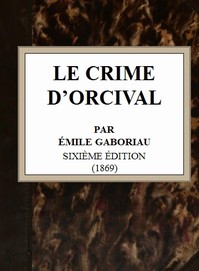
Le crime d'Orcival by Emile Gaboriau
If you're in the mood for a classic mystery that feels like the granddaddy of all detective stories, let me introduce you to Le Crime d'Orcival by Émile Gaboriau. Published way back in 1867, this book is where a lot of the detective fiction we love today got its start.
The Story
The peace of the village of Orcival is shattered when Count Hector de Trémorel is found brutally murdered in his study. His young wife, the Countess, has vanished. The scene is chaotic—a broken window, signs of a struggle, and a missing fortune in bonds. To the local police, it looks like a straightforward case: a robbery gone wrong, or perhaps a crime of passion with the wife as the prime suspect.
Enter Monsieur Lecoq, a detective from the Paris Sûreté. He's sharp, methodical, and doesn't trust first impressions. While others see an open-and-shut case, Lecoq sees contradictions. A footprint that doesn't match, a misplaced object, a story that feels too perfectly tragic. He starts to unravel a much more complicated web of deceit, involving hidden identities, old grudges, and carefully staged evidence. The real question becomes not just 'who did it,' but 'why does the crime scene feel like a theater set?'
Why You Should Read It
Reading this is like watching a master class in deduction. There's something incredibly satisfying about following Lecoq's logic. He notices the tiny details everyone else misses—the way a chair is positioned, the type of mud on a boot. You get to piece the puzzle together with him. Gaboriau also paints a vivid picture of French society at the time, showing how class and reputation can be motives all by themselves.
More than the mystery itself, I love the feel of it. It's all atmosphere: the gloomy chateau, the whispering villagers, the tension as Lecoq gets closer to the truth. It's a slower, more thoughtful burn than a modern thriller, but it pulls you right in.
Final Verdict
This book is perfect for anyone who loves the roots of a genre. If you're a fan of Sherlock Holmes, Hercule Poirot, or any detective who uses 'little grey cells,' you owe it to yourself to meet their literary ancestor, Monsieur Lecoq. It's also a great pick for readers who enjoy historical settings and mysteries that rely on psychology and careful observation over action. Just be ready for some classic French names and a puzzle that keeps you guessing until the very end.
Patricia Jackson
10 months agoText is crisp, making it easy to focus.
Donna Harris
7 months agoGreat read!
Kimberly Perez
1 year agoSurprisingly enough, the emotional weight of the story is balanced perfectly. I couldn't put it down.
Mary Thompson
1 year agoClear and concise.



Matthew Hill
1 year agoThis is one of those stories where the atmosphere created is totally immersive. A true masterpiece.